Showing posts with label Philadelphia. Show all posts

Sunday, January 16, 2011

The Ship of So Long Farewell


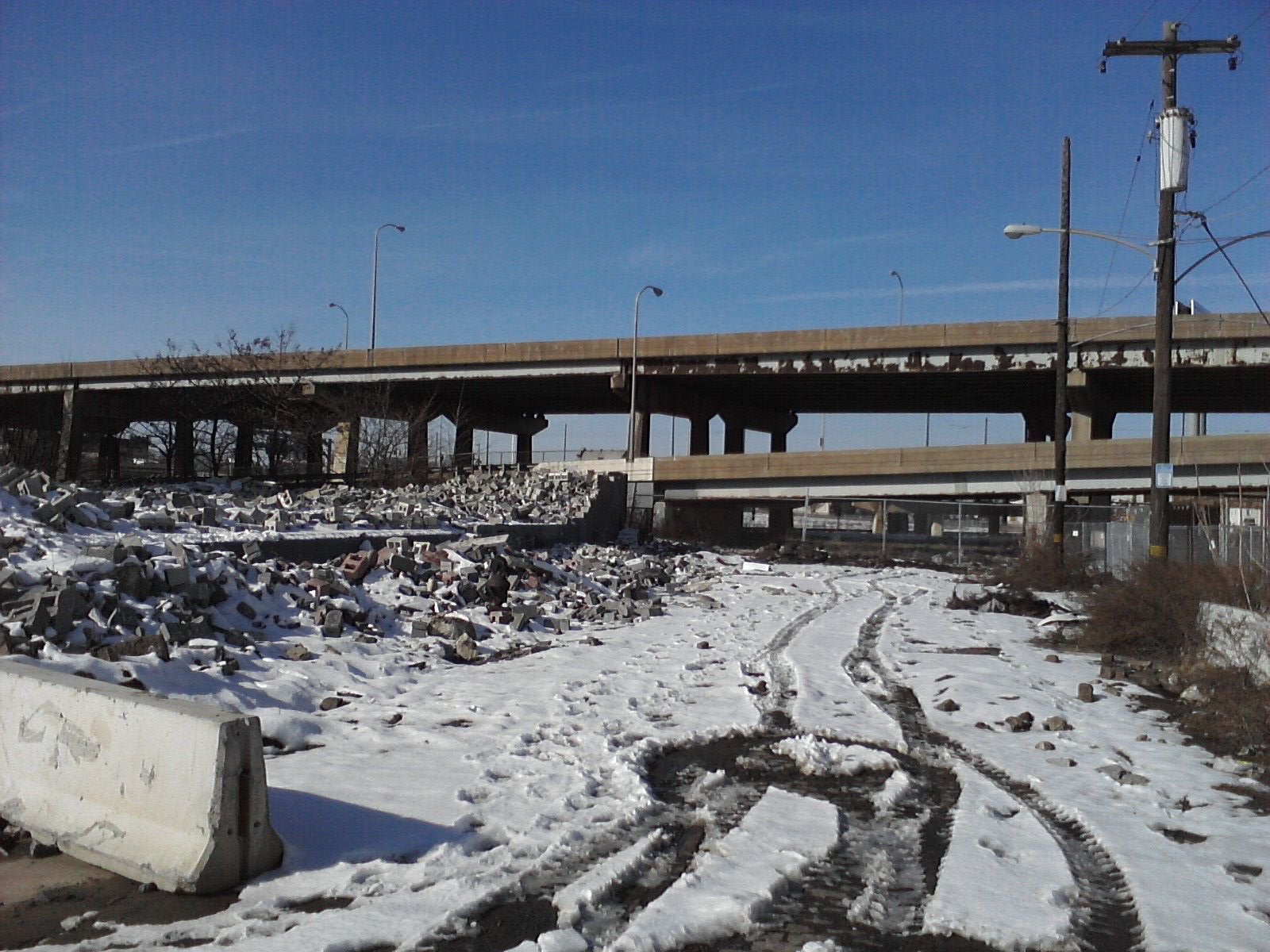
Transforming from being a place of (once upon a time) the largest maritime ship building complex in the world to an access ramp to I-95, the cramps building reveals itself brick by brick.


From being the leader in ship building, to the invention of The Slinky, the cramps building is taken apart to become part of another transportation system.


I suppose that history itself can not save a thing but can only aid in giving a thing added value.  History can comfort us in that we are connected to something larger than our time and lives, and it can fade away.  Who knows when structures will show their imprint on us in the future.  In the distant future some satellite taking pictures of vegetative growth through infrared sensors may reveal clues to who we are to who we will be.  We march through time because our 5th dimension self  manifests itself in 3 dimensions as what we experience in our comprehension.  Or something.

Monday, June 28, 2010

The Laser Sound of Our Cosmic History


"What walks down stairs, alone or in pairs, and makes a slinkity sound?
A spring, a spring, a marvelous thing! Everyone knows it's Slinky.
It's Slinky, it's Slinky. For fun it's a wonderful toy.
It's Slinky, it's Slinky. It's fun for a girl or a boy.
It's fun for a a girl or boy!"


So in my search for Philadelphia History I've come to this cosmic connection: The Slinky. 300 million Slinkies have been sold around the world. We've shared in walking it, putting it up to our ears and shaking it for laser beam sound effects, pinching our selves in its coils, and untangling it from itself. I find it perfect in its ingenuity, its simplicity, its working class affordability. Why would you let your children play with the mercury from a thermometer or roll each other down a hill in old tires when you can buy them a shipyard spring to slink down some stairs? Perhaps the most fun to be had with a slinky is setting up a course for it to walk down. The Cramps Shipyard, where the Slinky was invented, is bound for demolition. It is the last building of the preeminent ship building facility of the 19th century. It fell into disuse in 1947 and will finally be laid to waste by a junction of on and off ramps for I-95. Not a five-minute walk from our front door and you can see the overgrown bank of the Delaware river where the main Cramps building used to be. A few minutes walk back and you’ll see the building planphilly.com wants to conserve. It’s all looming angles and giant glass panes. It looks like a giant lego-brick airplane hangar. You may find this small painting HERE at my etsy store.

Friday, June 25, 2010

Don't Stop Till You Get Enough


So I almost forgot where I was when Michael Jackson died last year. That is how it starts, and then the memory eventually becomes like a deserted industrial building retaining the ghostly lettering of a business that no longer exists . . . eventually. It will be a long time before the estate of M.J. lets the money making machine of his cult of personality die. As this most recent series of paintings are of Philadelphia buildings I thought I'd delve into Philly's relationship to the King of Pop. In the mid 1970 two albums for Jackson and his brothers were produced under the Philadelphia International Records label. The albums were "The Jacksons" and "Going Places." According to news reports of the time Jackson wanted to start making songs with messages. I was old enough to remember "Thriller" coming out, but unlike my older brother, too young for parachute pants. And oh, was I jealous of all of those zippers and pockets. I mean what frog-string-stick-toy-penny in my pocket-kid wouldn't envy those. Granted the pants were too tight to make the pockets practical, and I already wore a pair of Roo's with the pocket on the side that I would get my milk money stuck in. At least they weren’t penny loafers. But that was in Georgia . . . in the shadow of Stone Mountain. This is about Philly, where everything is annoyingly spelled with a PH instead of an F. So like almost everything else in America's history Philadelphia can lay claim to another first, as the first place after Motown Records the Jacksons decided to record. Of course if you want to scrutinize it that is how most of Philly's phirsts are. They are kind of firsts. What I'm concerned with is more the demise of Philadelphia's landmark history. This painting is of the Edward Corner Marine Warehouse, and it’s deserted and the lettering has become ghostly. I've placed it in the background to further emphasize the fading memory of Philadelphia's maritime history. While M.J. is/was an international phenomena and maritime trading brought the world closer together, the cosmic unifier I started this series out with is more subtle. Its more tactile and is perfect in its American Ingenuity. Curious? All will be revealed next time.


If you like this painting and are interested in purchasing it please click HERE.

Thursday, June 24, 2010

Rambo: Schemes of the Rich and Mo' Power


What is one of the more interesting "historical" places on paper that can’t really be seen anymore around my neighborhood? Gunner’s Run. It was a creek turned into a canal that was used as an investment scheme and is now paved over. Hey, that does not sound cool. Well, boys and girls, it’s named after Gunner Rambo ca. 1847. I don't think its a stretch to connect it to Sylvester Stallone. . . . We have a Rocky Statue in front of the Philadelphia Museum of Art, now I suggest, no, demand that a statue of Rambo be place on the paved over-overgrown-Aramingo Canal where it once met the Delaware River. What could be more American than a statue of Rambo planted over a historical Philadelphia money pit? The new Delaware River Green Way welcome entrance could be a bronze statue of a savage man with a bowie knife in his mouth, a bow and arrow (tribute to Native Americans), and a plaque that reads: 1st capital of the United States, 1st continental congress, 1st Blood. If you don't like the bow and arrow Idea go HERE. Wasn't that what Rambo was about, opposing corrupt and bad American ideas? A little further North is The Richmond Power Plant. It is butted up against the Recycling plant and shipping wharves of Port Richmond. If you'd like to hang out by the high tension lines and listen to the hum of transformers for a while or two you may just be lucky enough to see a gleaming silver ACES train pass by taking people to Atlantic City.


You can litteraly feel the power in the air by the Betsy Ross bridge. When the 1876 World's Fair was happening, I imagine, they imagined future architecture to look like power substations. Just imagine thinking about the future at the exposition of A. Graham Bell's telephone, a typewriter, Heinz Ketchup, and another failed american project - Kudzu as an erosion control plant. Kudzu now spreads at a rate of 150,000 acres annually, according to Science Daily. It produces ground level Ozone for the South East enhancing the drawl of all in Y'all. If you are interested in purchasing a painting of an imagining of imaginings visit my Etsy site HERE. Kudzu and Rambo are still not the cosmic connection of generations that I"m leading up to though. 2 more posts and we're there. We're there already but I just have to reveal it slowly. I don't want anybody to be scared of the final surprise sprung. You're not a scaredy-cat are you? Then read on in a few.

Monday, June 21, 2010

Philadelphia Burning

With our recent trip to Japan I began to get used to all of these ancient land marks surrounding us. I began to wonder what we walk by everyday at home, in the U.S., and don’t even know or care is historic. We do live in Philadelphia, some big history for the country there, but what about our neighborhood? What do we have in our ‘hood that is similar in importance to what is in Motoko’s Parents in Japan? Is there anything? I drove around our neighborhood and tried to explore some areas that the local preservation group is trying to have deemed important for Philadelphia’s history. I was a nice day out so I brought along the camera to shot some photos for painting references, and sketched some as well. I started out at planphilly.com and looked through the points of interest, chose our driving path of least resistance, and hopped in the car/truck thing to go and breathe some fresh (questionably) air. It was fresh. The area we live in is up for, a name calling, debate. Things can get heated between city folk about where they are from and what neighborhood is what and authentic real estate agents will get into fisticuffs over it. Being a transplanted southern boy now living in the lowest part of the North’s denial, which it’s the same as the southeastern coast, I had to define again where I live and joined in on the fun. Technically we live in what was historically called Olde Richmond. It is now considered part of Fishtown (sigh of relief). So what is all this coming to? I can proudly stand up and say, “I have had a connection to my current neighborhood all my life!” If you are, not quite a person of a certain age, are a person of a certain age, or progeny of said people you too have this cosmic connection.

I’ll start at the beginning and we'll work our way to the cosmic connection by the end of the week.
My first stop was the music club The Barbary has been around since 1969 and is up for a nomination into the historical preservation society. Their page= www.myspace.com/thenewbarbary


That Music Venue that is so cool it is almost historical, but would never claim outright that it is because that - would be uncool.

According to wiki-travel it is “Hipster Heaven.” I can’t find any information about its importance to music except that it’s been around for a while. Someone let me know about that one please. Its name is interesting in context of the city considering this: the USS Philadelphia was lit aflame by its own people in the first Barbary war.

I will be posting a new Philadelphia 19125 painting every day over the next 5 days. You can purchase them off of my etsy site for $60.00 eachHERE. These paintings are mounted onto 6"x8" frames. Hey, even figure painters need to paint landscapes. After these it is on to the Child Ballad work, http://www.facebook.com/#!/pages/The-Child-Ballads-Show/127757983923416?ref=mf .

Friday, May 28, 2010

Mounting the Dohyo

Continuing the dainty daily sumo paintings... a little more history about the match preparation paraphrased from wikipedia, "On mounting the dohyō, which takes its name from the straw rice bag which mark out different parts the ring, the wrestler performs a number of rituals derived from Shinto practice. Facing the audience, he claps his hands and then performs the leg-stomping shiko exercise to drive evil spirits from the dohyō as the "Gyōji, or referee, who will coordinate the bout announces the wrestlers' names. Stepping out of the ring into their corners, each wrestler is given a ladle full of water, the chikara-mizu ("power water"), with which he rinses out his mouth; and a paper tissue, the chikara-gami ("power paper"), to dry his lips. Then both step back into the ring, squat facing each other, clap their hands, then spread them wide (traditionally to show they have no weapons). Returning to their corners, they each pick up a handful of salt which they toss onto the ring to purify it."
The literal translations of power water and power paper remind me of my early child hood. Running around the woods making forts and popping sweet-tarts claiming they were power-pellets when we needed the extra strength to move a tree or quickness to catch a crawdad. It was ritual to flick them into one's mouth, flex the guns, and if something needed stomping to stomp it. I'm sure it was all due to some strange Pac-man/G.I. Joe/M.A.S.K./He-Man influenced sugar high. Early sumo was a rough-and-tumble affair combining elements of boxing and wrestling with few or no holds barred. I'm sure they would have liked some power-pellets to go along with the water and paper. Especially since there are no weight classes. A wrestler can easily find himself up against an opponent twice his size.
Looking back at some of my favorite paintings made by George Bellows of the Ashcan school, (early enough in the 20th century that New York artists would come to Philadelphia for inspiration) I can see how the physicality and meat-like quality of the pugilists spill into their opponents.
While I enjoy these grisly paintings and have tried to retain some of the "weight" of the opponents, the atmosphere in which I was brought to Sumo wrestling was not as bloody or seedy. Well maybe seedy in a different way. Insinuating how we think of origami and painting these larger than life men on floral origami paper I wanted to emphasize the ritual of the event and juxtapose their girth against an ostensibly fragile plant. Sumo, after all, did have its origins as a Shinto agricultural planting ritual in hopes of a bountiful season. The Sumo ring is topped by a "tsuriyane", or suspended roof, that resembles a Shinto shrine. This diptych is before the match as the dohyo is physically and spiritually cleaned. I have left the standing wrestler "floating" a little to further emphasize this part of the ritual as the wrestlers will become more grounded as they engage.


To purchase these paintings or look at others click HERE.
Next time the Evil Spirits will be driven away!?
 
Analytica Tracking: